

The Journey Stops Being Dead Time
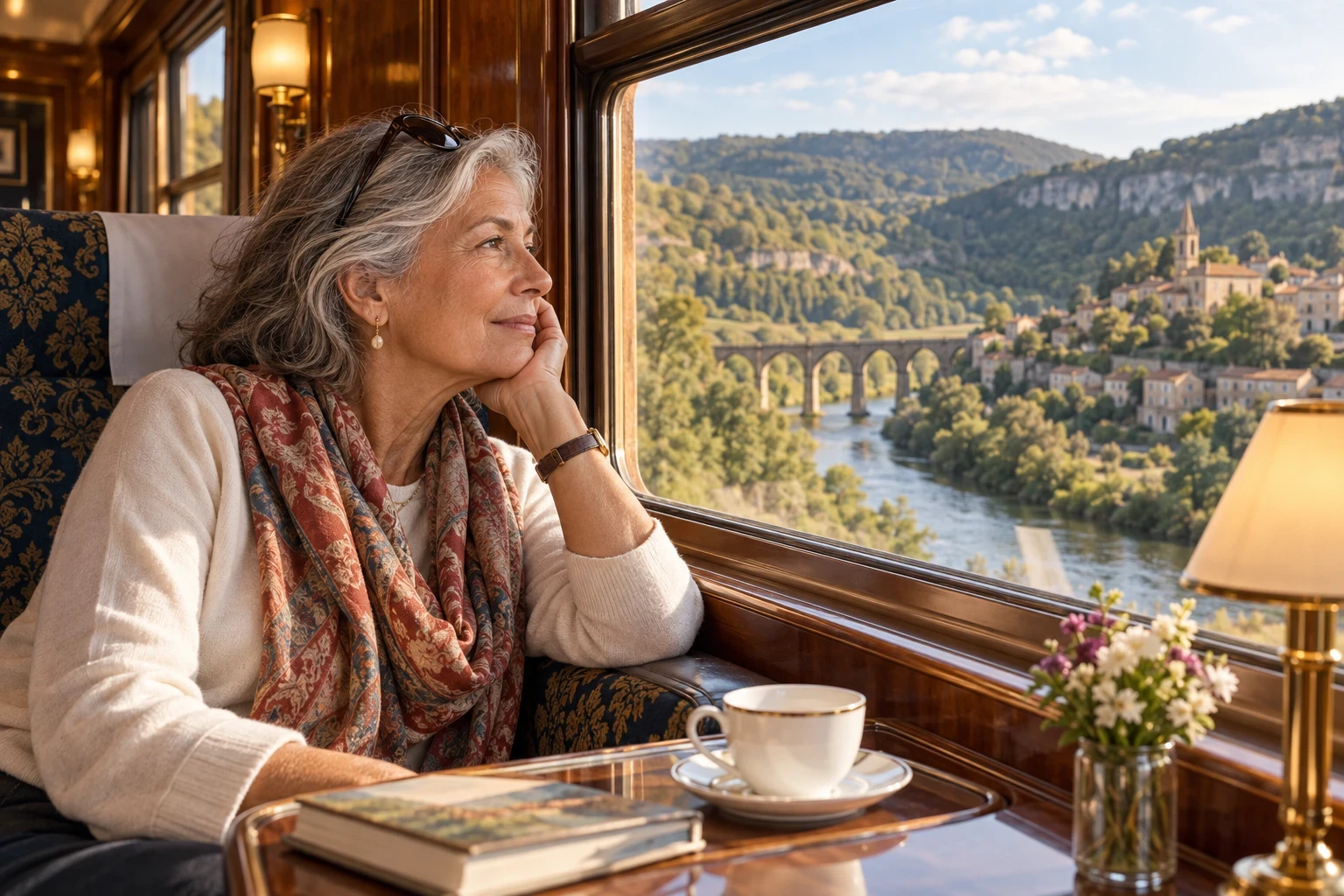
Imagine settling beside a train window with an entire afternoon still ahead. Your bag is stowed; there is nothing to navigate for a while. Outside, the backs of buildings give way to gardens, then fields. You notice a footbridge, a bend in a river, someone waiting at a level crossing. None of these things would justify a separate excursion. Together, they make you feel that you are going somewhere, rather than simply being delivered there.
This imagined afternoon contains the strongest argument for a no-fly holiday. Its luxury is not necessarily a polished dining carriage or a bed made up while you eat. It is the possibility of restoring anticipation, observation and continuity to travel. The journey becomes part of the holiday rather than an interval to endure.
That is the central promise of slow travel by train—and also its qualification. Not every train is comfortable, not every view remarkable, and not every traveller enjoys several hours in one place. A railway ticket alone cannot turn a crowded schedule into a restful experience. The glamour depends as much on what you leave out of the itinerary as on what you book.
Flying can be the sensible choice, especially across oceans or when leave is limited. There is no need to diminish it to appreciate something different. Rail asks another question: what if the time spent getting there offered something you wanted in its own right?
Perhaps that is uninterrupted conversation. Perhaps it is the freedom to read without feeling that you should be visiting a museum. Perhaps it is watching the landscape change slowly enough to understand how one place connects to another.
These pleasures need protecting. If you spend the afternoon worrying about a tight connection, the window becomes background to a timetable. If your idea of comfort includes quiet and privacy, a lively shared carriage may disappoint however beautiful the surroundings.
Begin, then, not with the most glamorous photograph, but with a personal definition of a good travelling day. What would make the hours on board feel well spent? Your answer is a better guide than the word ‘luxury’ on a brochure.
Two Meanings of Rail Luxury: Europe’s Grand Routes and America’s Big Landscapes
A useful distinction lies between a train chosen for its hospitality and a train chosen for what lies beyond its windows. These experiences can overlap, but they are not interchangeable.
When considering luxury train travel in Europe, separate the appeal of the onboard experience from the appeal of the itinerary. A beautifully presented meal, attentive service and a private compartment belong to one category of pleasure. Towns, countryside and time ashore belong to another. A journey might satisfy both, but the description needs to explain how, rather than allowing elegant interiors to do all the persuading.
Consider a hypothetical couple choosing a special-occasion trip. One wants leisurely meals and somewhere comfortable to dress for dinner; the other wants long stretches of daylight scenery. Neither preference is more discerning. But unless the schedule, accommodation and dining arrangements suit both, an expensive booking could become an exercise in compromise.
The practical response is to read the itinerary as a sequence of hours, not merely a list of destinations. When would you be looking out of the window? When would you be eating, sleeping or away from the train? A place appearing on a map does not, by itself, tell you how much of it you will experience.
For scenic train rides in the USA, start with the same discipline from the opposite direction: if landscape is the main attraction, what conditions would let you enjoy it? Daylight matters. So do a comfortable seat, a tolerable journey length and clarity about the facilities available with your particular ticket. Do not assume that a scenic service offers the privacy or hospitality associated with a dedicated luxury journey.
These are planning lenses, not national categories. Europe need not mean formality, and an American journey need not be about scenery alone. The useful distinction is between luxury as service and luxury as time, space or access to a view.
Before comparing prices, rank your three essentials. They might be a private bathroom, interesting scenery and unhurried meals; or a straightforward itinerary, quiet surroundings and generous time at the destination. Then identify what you can happily forgo.
This exercise makes the comparison more honest. A modest daytime journey followed by a comfortable hotel could suit you better than a prestige overnight experience. Equally, a carefully chosen onboard experience might be the entire point of the holiday, rather than an indulgence added to it.
Designing a Rail-First Holiday Rather Than Collecting Train Segments
The temptation, once a rail map is open, is to keep adding places. Lines join so neatly on paper. A city appears close to another city; an extra border looks like a small flourish. Soon a holiday intended to slow things down contains a new departure every morning.
A more satisfying design begins with a manageable corridor and a reason to travel through it. Choose the landscape, cultural interest or particular journey that matters most, then organise the rest around that. One or two bases can offer more room for discovery than a string of single-night stops.
Imagine, for example, a hypothetical week built around one substantial scenic journey. You might spend the first few nights in one place, take the train in daylight, then stay several nights at the other end. Local outings remain optional. The main journey has space around it, and a delayed arrival does not immediately threaten the next departure.
The tradeoff is fewer destinations. That can feel uncomfortable when you have travelled far or saved for a long time. Yet the relevant comparison is not between places visited and places missed. It is between the holiday you can comfortably inhabit and the itinerary you can technically complete.
Give each railway leg a purpose. One might offer a memorable view; another might simply be the easiest way to your next base. There is no need for every segment to be exceptional. Combining a special journey with ordinary rail travel can also help you direct spending towards the experience you value most, though the actual costs need comparing.
Treat arrival as part of the plan. Where will you go from the station? Can you reach your accommodation without a difficult transfer? Will there be somewhere to leave luggage if your room is not ready? These unglamorous questions determine whether your first afternoon feels spacious or exhausting.
For travellers starting in India or another long-haul market, the wording deserves honesty. A European or North American rail holiday may be flight-free within the destination, rather than no-fly from home. Acknowledge the flight instead of treating the entire trip as something it is not. If avoiding aviation altogether is essential, start by examining what is realistically reachable from home and the formalities involved.
Finally, leave some time unassigned. A free morning after a long journey is not a failure of planning. It is room to sleep, walk, change your mind or simply enjoy being somewhere without immediately preparing to leave it.
The Friction Is Real—and Worth Planning Around
Romance is a poor substitute for checking the details. Before paying, establish exactly what the fare covers: accommodation or seating, meals, excursions, transfers and any other elements important to you. The premium attached to a prestige experience needs to make sense against your priorities, not merely the photography.
Set a whole-trip budget rather than a ticket budget. Include accommodation between journeys, station transfers, meals not included and enough contingency to manage disruption. If the experience you want exceeds that budget, shorten the special rail element or choose a simpler journey. Compromising on everything else to afford one glamorous night may undermine the holiday around it.
Time needs a budget too. Check current departure dates before building other bookings around a particular service. Where tickets are sold separately, establish what happens if a delay causes a missed connection. Do not assume that every onward arrangement will be protected. A generous buffer, or an overnight stop before an important departure, may be worth more than another sightseeing opportunity.
Comfort requires similar precision. ‘Sleeper’ does not answer questions about bed access, usable floor space, bathroom arrangements or how a compartment works at night. Nor does a premium label establish that you will sleep well with movement and unfamiliar sounds. If uncertain, a daytime rail journey and a stationary bed offer another way to enjoy the route.
Accessibility should be checked against the actual train, station and accommodation you intend to use. Ask about boarding, steps, passageways, toilets and assistance procedures relevant to your needs. Describe what would make the journey workable rather than relying solely on broad terms such as ‘accessible’ or ‘assisted’. Request clear confirmation before committing to arrangements that depend on it.
Luggage is another quiet determinant of ease. Pack for what you can comfortably manage through the planned transfers, unless handling assistance is explicitly confirmed. A bag that is convenient in a hotel corridor may be awkward around steps or in a compact compartment. Leave out clothing that serves an imagined version of the trip rather than your actual plans.
Check passport, visa and transit requirements for your nationality and itinerary through appropriate official sources. Crossing a border by rail does not remove the need to understand entry conditions. Likewise, verify current ticket-change and cancellation terms directly.
If motion, shared space or disrupted sleep concerns you, let that shape the itinerary from the beginning. Choosing a shorter first journey is not settling for less. It is a way to find out whether the rhythm suits you before making it the centre of a longer holiday.
A More Deliberate Departure
There is a version of rail romance that can become strangely demanding: the right clothes, the right luggage, the right attitude towards taking one's time. It turns a holiday into a performance of elegance. You do not need to participate.
The pleasure of a rail-first trip may be much less elaborate. It might lie in having only one important thing to do that day: board the train. Or in discovering that you enjoy breakfast before departure more when there is no packed programme waiting at the other end. Glamour, in this sense, is the absence of unnecessary hurry rather than an obligation to look a certain way.
Nor is slow travel a moral test. Available leave, caring responsibilities, budget and personal comfort all shape what is possible. A short direct flight may serve one holiday better; a long railway journey may give another its character. The useful decision is the one that recognises those differences without apology.
You can begin today with a single sheet of paper. Sketch one journey whose route interests you, not just its destination. Beside it, write what you hope to gain on board: scenery, privacy, conversation, a memorable meal or simply a quieter day.
Then compare it honestly with flying. Allow for the full door-to-door time, all likely costs, the effort of transfers and the comfort you actually need. Mark the details still requiring confirmation. If the rail option only works when everything goes perfectly, simplify it.
If it still appeals after that exercise, you have something more useful than a fantasy: the beginnings of a holiday designed around how you want to feel while travelling.
The destination remains important. But it need not carry the entire burden of making the trip worthwhile. Somewhere between departure and arrival, there may be room for a day you would otherwise have hurried through—and enough attention left to notice it.