
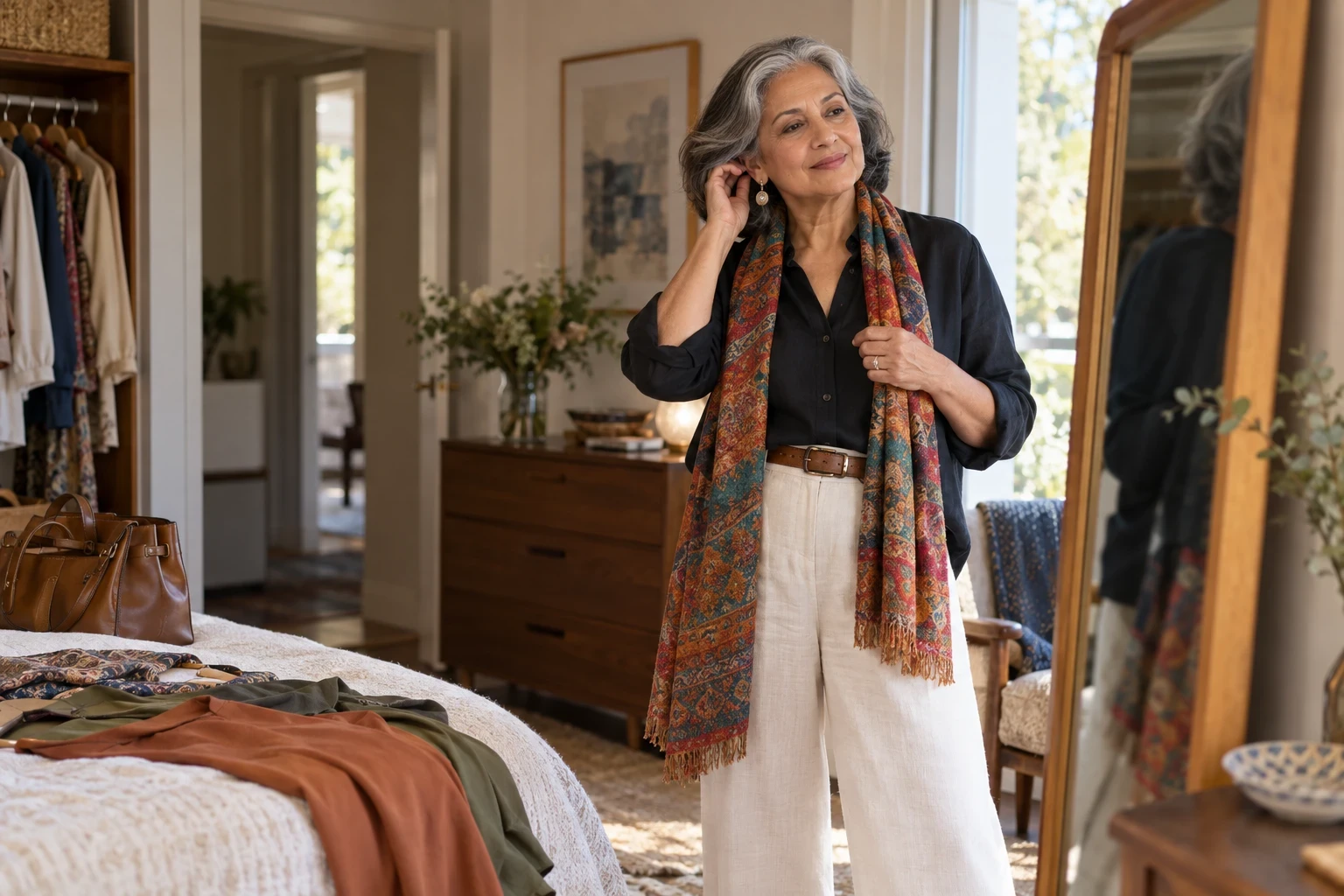

Imagine getting ready for a dinner you have been looking forward to. The wardrobe is full, the bed is collecting rejected outfits, and the shirt you usually trust suddenly seems wrong with everything. Nothing disastrous has happened. Yet the person in the mirror does not quite match the person you feel yourself to be.
The temptation is to assume something needs replacing: the shirt, the wardrobe, perhaps your entire approach to dressing. Before reaching for a shopping app, consider a smaller question. Is the outfit wrong—or does one relationship within it need adjusting?
A sleeve pushed back, a different trouser length, a stronger colour near the face: these are modest interventions, but they give you something useful to examine. Exceptional dressing after 50 is not a separate category of fashion. It is the practice of making fit, proportion, fabric, colour and context work together, on your terms.
From looking younger to looking more like yourself
There is no particular birthday at which a print becomes too loud, jeans become inappropriate or an interesting shoe requires an explanation. Equally, nobody owes the world a display of daring. Quiet dressing can be distinctive; exuberant dressing can be entirely comfortable. The useful question is not whether an outfit is youthful or restrained, but whether it expresses what you want to express.
Start with three qualities you would like your clothes to convey. They might be relaxed, precise and playful; fluid, grounded and elegant; or practical, colourful and unconventional. These are not personality tests. They are editing tools. When an outfit feels unsettled, they help you identify why.
In a hypothetical example, someone who values ease and precision might enjoy generous trousers with a crisp shirt, but feel uncomfortable in a heavily embellished jacket. Someone drawn to drama might find the same shirt-and-trouser combination unfinished until a sculptural necklace or vivid scarf enters the picture. Neither needs correcting towards the other.
Your preferences can change without making your earlier choices mistakes. A different job, climate, routine or relationship with visibility may call for a different wardrobe. You might want more colour now, or less ceremony. You might simply no longer enjoy clothes that require constant attention.
That is the first practical distinction: dress for the life you actually lead, not a role you feel obliged to perform. Before judging a garment, ask where you would wear it, how you would move in it and whether you would recognise yourself in it. Keep pleasure in that assessment. Clothes need not be universally useful to deserve a place; they should have a reason for being yours.
Start with the silhouette, not the shopping list
Before looking at labels or details, look at the overall shape. Where does the outfit widen, narrow, begin and end? Does the eye encounter a clear line, or several hems and edges interrupting one another? There is no ideal silhouette for everyone. The aim is to notice the one you are creating rather than accept it accidentally.
Fit is not the same as tightness. A generous garment can fit beautifully when its shoulders, neckline and volume sit as intended. A close-fitting piece can work equally well if it allows the movement you need. Shape does not have to mean revealing a waist, and ease does not have to mean hiding a body.
Use the mirror as a starting point, then test the clothes in motion. Sit down, reach forward, take several steps and bend as you normally would. Notice a waistband that feels acceptable standing but digs in when seated, a shirt that pulls across the back, or a sleeve that interferes with your hands. These are garment problems to investigate, not personal shortcomings.
Length is a particularly useful adjustment. Try trousers with the shoes you intend to wear: a hem that looks considered with one pair may pool over another. Check where a jacket ends against the layer beneath it. A deliberate difference in length can be interesting; a narrow strip showing accidentally may look less resolved to you.
Consider a hypothetical outfit of wide trousers and a long, loose shirt. If it feels more voluminous than you want, experiment before rejecting either piece. Open the neckline, fold the sleeves, try a partial tuck if comfortable, or substitute a shorter layer. The purpose is to discover your preferred balance, not enforce a rule that loose must always be paired with tight.
Sizing labels are an imperfect guide, so assess the garment rather than the number. If your measurements fluctuate, adjustable fastenings, forgiving cuts or a little extra ease may serve you better than a fit that works on only one kind of day.
Alterations deserve consideration, but not blind faith. Ask a tailor what is feasible and what it will cost before buying something that needs work. A straightforward hem adjustment is a different proposition from rebuilding a shoulder or changing a garment’s whole shape. Compare the total expense with how often you genuinely expect to wear it.
For today, examine one frequently worn outfit from shoulder to shoe. Choose just one junction—cuff, waistband or hem—to adjust. This is a more informative exercise than deciding that everything is wrong.
Build a wardrobe around reliable building blocks
A useful wardrobe is not necessarily small, neutral or expensive. It is one in which enough pieces cooperate to make getting dressed manageable. Rather than beginning with a universal essentials list, begin with your week. Work meetings, market trips, travel, caregiving, religious gatherings and evenings out make different demands. Your wardrobe should reflect your particular mixture.
Look for anchors: garments around which you can reliably build an outfit. These might be straight trousers, an easy skirt, a favourite kurta, a well-cut shirt, a sari you enjoy wearing, or jeans in a shape that suits your routine. An anchor is defined by its usefulness to you, not its status in a style guide.
Then identify the supporting pieces. What goes underneath? Which layer works over it? What footwear makes the whole combination practical? An attractive item that needs three additional purchases may be less useful than a modest one that completes several outfits already waiting in the wardrobe.
For a hypothetical person whose week includes video meetings and local errands, two dependable bottoms, several interchangeable tops and one light outer layer might provide a strong working group. Another person may need distinct wardrobes for a formal workplace and hands-on responsibilities at home. There is no virtue in forcing both lives into the same handful of clothes.
Fabric should be assessed through use, not prestige. Handle it, see how it drapes and check the care label. Does it hold the line you want? Is it too sheer for your preference? Will you realistically iron it or arrange specialist cleaning? A beautiful garment that spends months awaiting care is not necessarily a good everyday building block.
Climate matters as much as appearance. In hot or humid conditions, consider whether a proposed layer is genuinely wearable. Where temperatures change markedly between outdoors and air-conditioned interiors, a removable layer may be more adaptable. In wet weather, a trouser hem and shoe combination that copes with your journey deserves priority over a photographically perfect look.
Budget decisions become clearer once you identify the real gap. Before buying another top, check whether the missing element is actually suitable footwear or a layer that works with your existing clothes. Try assembling three complete outfits from what you own and write down the point at which each stalls.
Spend according to use, pleasure and what you can comfortably afford—not the assumption that a higher price guarantees a better result. A versatile base is valuable because it leaves room for expressive exceptions: the embroidered waistcoat, unusual print or brilliant colour that makes you smile. Reliability should support individuality, not flatten it.
Make colour, texture and accessories do purposeful work
Once an outfit functions, details can make it memorable. You do not need to add several at once. Sometimes the most effective change is a colour repeated in two places, a textured fabric against a smooth one, or a familiar accessory moved into an unexpected combination.
Approach colour through observation rather than prohibition. Hold two garments near your face in similar daylight and ask which effect you prefer. One may feel crisp, another gentle, another wonderfully assertive. You are choosing an expression, not passing a test of what your colouring supposedly permits.
If a colour you love feels difficult near your face, try it elsewhere: in trousers, a bag, footwear or a narrow detail. Nor must your entire wardrobe agree on one palette. A few colours that combine readily can provide continuity while leaving space for less cooperative favourites.
In a hypothetical outfit, deep blue trousers and a blue shirt could become more distinctive with rust-coloured footwear or a patterned scarf. A cream kurta and trousers might take on a different character with a dark textured waistcoat. Neither combination depends on age or gender; each uses a clear contrast to establish a point of view.
Texture offers another route, especially if you prefer restrained colour. Consider the difference between an entirely smooth outfit and one combining a fine knit with a more structured jacket. Matte cloth beside a little sheen can be enough interest for an evening. Check the combination in the light in which you will wear it, where possible: what seems subtle in daylight may become more noticeable under indoor lighting.
Accessories work best when they have a job. A belt can mark a transition; eyewear can introduce a strong line; a watch, ring or brooch can bring personal meaning. A bag must also carry what you need without becoming an inconvenience. Beauty and utility are allowed to negotiate.
One focal point is a useful starting method, not a ceiling on creativity. If you are uncertain, choose the element you want noticed first and let the others support it. If you enjoy several statements together, look for a connection—shared colour, scale or mood—that makes their conversation feel intentional.
Try changing only one accessory in a familiar outfit. Compare a delicate piece with a bolder one, or a soft scarf with a clean neckline. Notice not only the visual result but whether you keep adjusting it. An accessory that demands more attention than you want to give it may be right for a short celebration and wrong for a busy afternoon. Context settles many supposed style dilemmas.
Be selective with trends—and honest about comfort
Looking current does not require keeping pace with every new silhouette. It can mean revisiting the proportions you have worn on autopilot and deciding whether they still please you. Fashion is useful as a source of possibilities; it becomes less useful when it persuades you that an otherwise satisfying wardrobe has expired.
When a new shape or detail catches your attention, isolate what attracts you. Is it the colour, the looseness, the sharpness or the contrast with something familiar? Test that element with clothes you already trust. There is no need to adopt the complete look in which you first encountered it.
For a hypothetical reader curious about a wider trouser shape, trying it with a familiar shirt and shoes offers a clearer assessment than simultaneously changing every part of the outfit. If the result feels unfamiliar, give yourself room to distinguish novelty from dislike. You need not buy it to conduct the experiment; a fitting-room trial may tell you enough.
Comfort is information, not surrender. A garment that scratches, constricts or needs repeated pulling into place is telling you something relevant about its suitability. So is footwear that makes you reluctant to walk the distance your day involves. Visual impact matters, but it is not the only measure of success.
Trade-offs can still be deliberate. You may happily manage a more elaborate outfit for a seated occasion while choosing simpler clothes for a long journey. Test the actual demands: steps, fastenings, carrying a bag, using a washroom or putting on an outer layer. Where you have specific mobility or footwear needs, let those requirements lead rather than expecting a general style suggestion to override them.
Shopping habits deserve the same honesty. Before ordering online, compare the supplied garment measurements with a similar piece that fits you, where those details are available. Check fabric information, care instructions, return conditions and any alteration costs. Photographs cannot settle every question about feel, fit or movement.
Sentimental clothes need a different decision. A garment can matter without remaining in daily rotation. If space allows, separate treasured pieces from working clothes so that affection does not make every morning harder. You may later wear, adapt or simply keep them; usefulness is not their only value.
Finally, do not confuse boldness with somebody else’s personality. Your version might be a bright sock, a substantial ring or an uninterrupted sweep of one colour. Before an impulse purchase, name the occasion and at least one complete outfit it belongs to. If its only purpose is to make you a different person, pause. Clothes can extend your expression without having to replace it.
Create a five-minute dressing practice
The most useful style framework is one you can remember when you are already running late. Once you have explored your preferences, turn them into a short routine rather than repeating the whole investigation every morning. Five minutes is a guide, not a deadline or another standard to meet.
Begin with the day, then build the outfit
Choose the priority. What does this day require most: freedom of movement, formality, weather protection, ease during travel, or a sense of celebration? There may be several needs, but naming the leading one helps prevent an attractive yet impractical choice from directing everything else.
Start with one reliable anchor. Select a garment you know works for that priority. It might be a favourite pair of trousers, a dress, a kurta or a shirt. Build from that certainty rather than pulling out unrelated favourites and hoping they will cooperate.
Add one point of interest. Use colour, texture, an accessory or a change in proportion. On days when you want simplicity, the interest can be subtle: a neatly exposed cuff, an unusual fastening or a pleasing contrast between two fabrics. You do not have to make a statement every time you leave home.
Check movement and the whole line. Put on the actual footwear and any outer layer. Sit, reach and walk. Then view the outfit as a whole rather than inspecting isolated body parts. Ask whether the clothes are doing what you intended and whether any adjustment would make the day easier.
Edit only what needs editing. Remove a detail if it competes with the effect you want; leave it if it belongs. The familiar instruction to take something off is not a law. Sometimes the missing element is precisely what gives an outfit coherence.
Keep your own useful evidence
When a combination works, photograph it for yourself or make a short note. Record the shoes, the layer and the occasion, not simply the main garment. You are building a personal reference that can save time, not producing content or inviting judgement. Include how the outfit felt after several hours; the mirror supplies only part of the answer.
Today, choose one familiar outfit and make a single deliberate adjustment. Wear it rather than merely assessing it on a hanger. See whether the change improves its line, usefulness or sense of being yours.
Exceptional dressing need not announce a transformation. It can be the quieter satisfaction of leaving the mirror without another correction, knowing your clothes suit the day and leave your attention free for living it.